Extension Of Monte Carlo Analysis To Include Braking System Control Loops For The Improvement Of Braking Curves
Abstract
Since 2010, the European Union Agency for Railways (ERA) has accepted the stochastic Monte Carlo method in principle as a viable option for calculating ETCS emergency braking curves. However, the method also offers considerable potential for modeling the mutual relationships within braking systems. If control loops of a system are integrated into the method, it can allow more precise calculation of braking curves, which means that the same level of emergency braking safety could be achieved by applying a lower margin in the form of a higher Kdry_rst value. This would provide opportunities for reducing train headways and thus increasing on-track throughput – without in any way compromising safety. But to bring this potential real-world benefit “to the track” before the impending launch of ATO, it is important to clarify how best to integrate K (correction factor) values computed using the Monte Carlo method into the prevailing safety certification.
—
Since 2010, the European Union Agency for Railways (ERA) has accepted the stochastic Monte Carlo method in principle as a viable option for calculating ETCS emergency braking curves. However, the method also offers considerable potential for modeling the mutual relationships within braking systems. If control loops of a system are integrated into the method, it can allow more precise calculation of braking curves, which means that the same level of emergency braking safety could be achieved by applying a lower margin in the form of a higher Kdry_rst value. This would provide opportunities for reducing train headways and thus increasing on-track throughput – without in any way compromising safety. But to bring this potential real-world benefit “to the track” before the impending launch of ATO, it is important to clarify how best to integrate K (correction factor) values computed using the Monte Carlo method into the prevailing safety certification.
1 Quo vadis, Monte Carlo method?
Luxury yachts, a spectacular Formula One race, casinos… those are the three things most people will think of as soon as they hear the words “Monte Carlo”. But people familiar with probability theory may also think of a stochastic method of computation named after the city-state and used to describe a lengthy series of consecutive random experiments. In theory, these random experiments could be carried out in the real world by rolling dice – but this would, of course, take far too long, which is why computer processors are generally used to generate the random numbers.
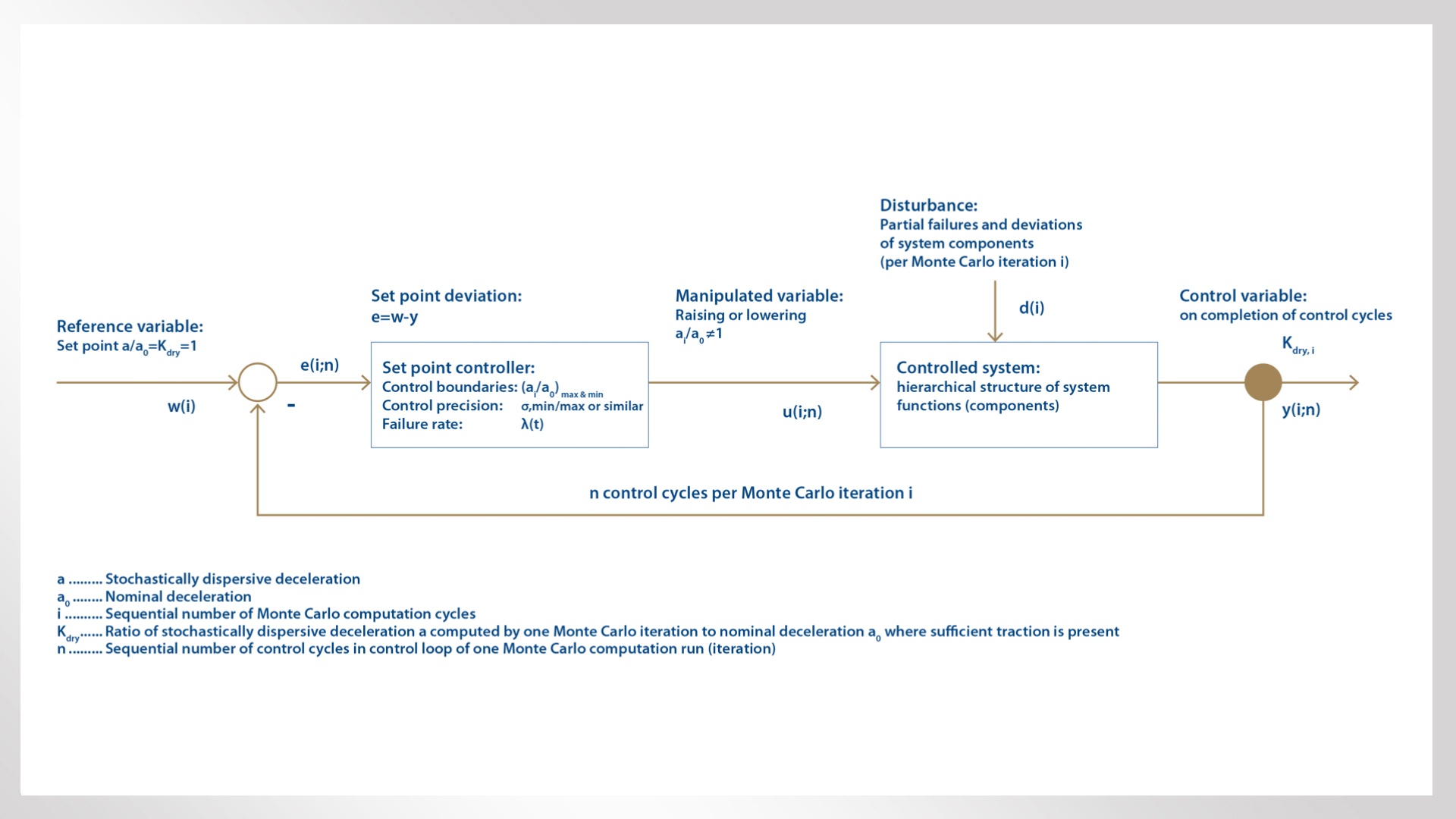
The method is extremely useful for calculating statistical averages and deviations. In 2006, UIC submitted a proposal for using the method to calculate ETCS emergency braking curves [1]; four years later, it was accepted as a viable option by the European Union Agency for Railways (ERA) [2]. But the method could also be useful not just for analyzing failure probabilities and performance variations at one hierarchical level in a braking system, but for contributing to the overall design of the braking system, as part of its control loop. This would make it possible first, to draw conclusions about the requisite operational ETCS braking curves at this very early stage in the development process, and second, to calculate the braking curves themselves more precisely.
2 How the methodology has been used to date
3 Incorporating braking system control loops into the Monte Carlo method
4 Productive application of the method in braking system design
This approach, which now takes account of the interdependencies between the individual braking system components, generates attractive added value in multiple respects. First, Monte Carlo-generated Kdry_rst values would help developers put together modular design concepts where they were previously limited to a specific, defined braking system architecture. And second, the Monte Carlo method could help them calculate dynamic braking behavior – and thus explicitly quantify the extent to which the assumed failure of an arbitrary system component could be offset by another of the train’s onboard braking functions, thereby enhancing operational resilience.
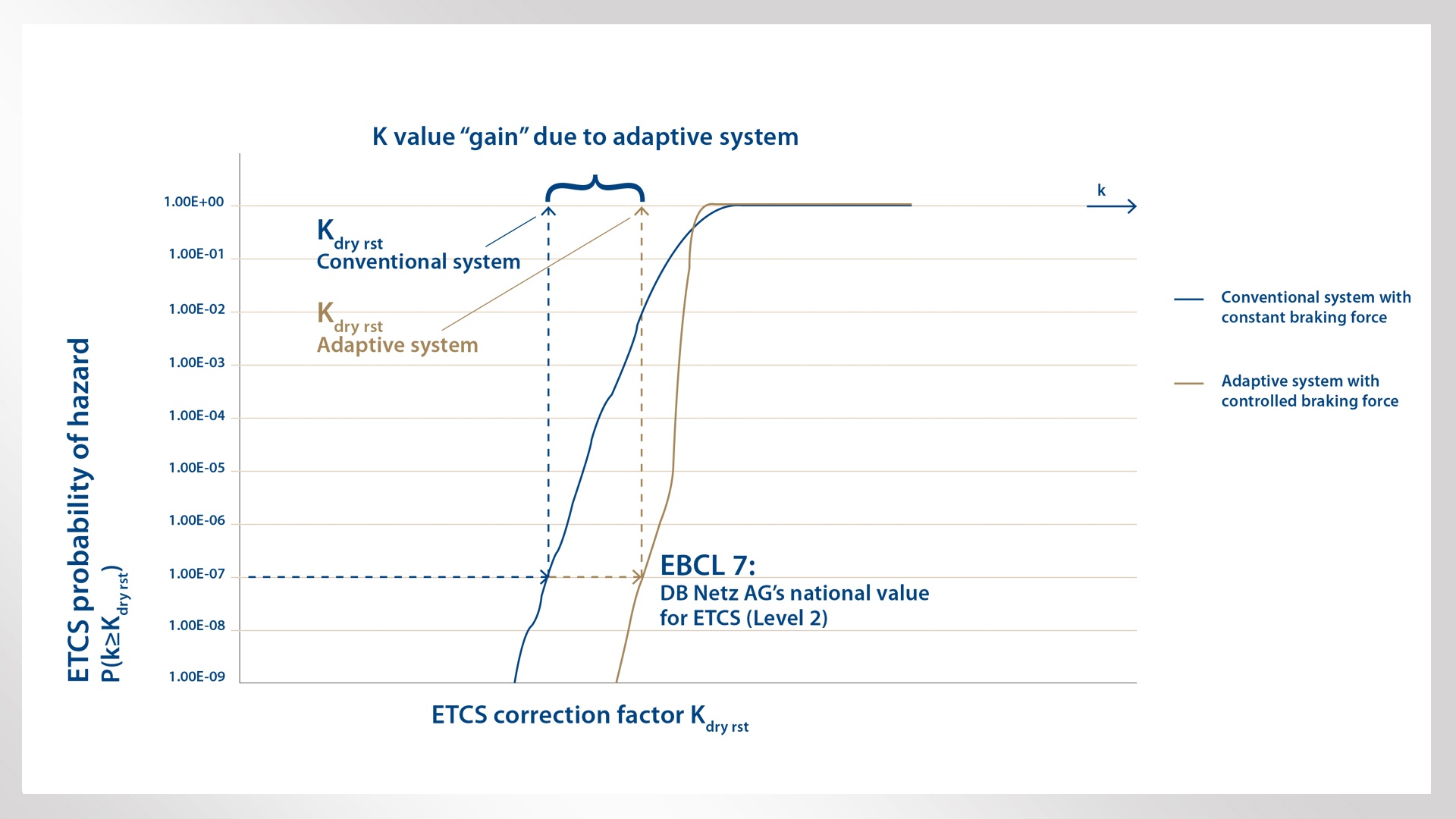
Conversely, the more precisely calculated braking curves mean that the same EBCL could now be achieved by applying a lower “buffer” in the form of a higher Kdry_rst value. Once the resilience of this approach is validated by the relevant safety tests, trains could run at shorter intervals without compromising safety, and thus increase the throughput of a given section of track.