- Original
- Website
- Social Media
Item 1
Item 2
Contributor:
Item 2
Item 2
Contributor:
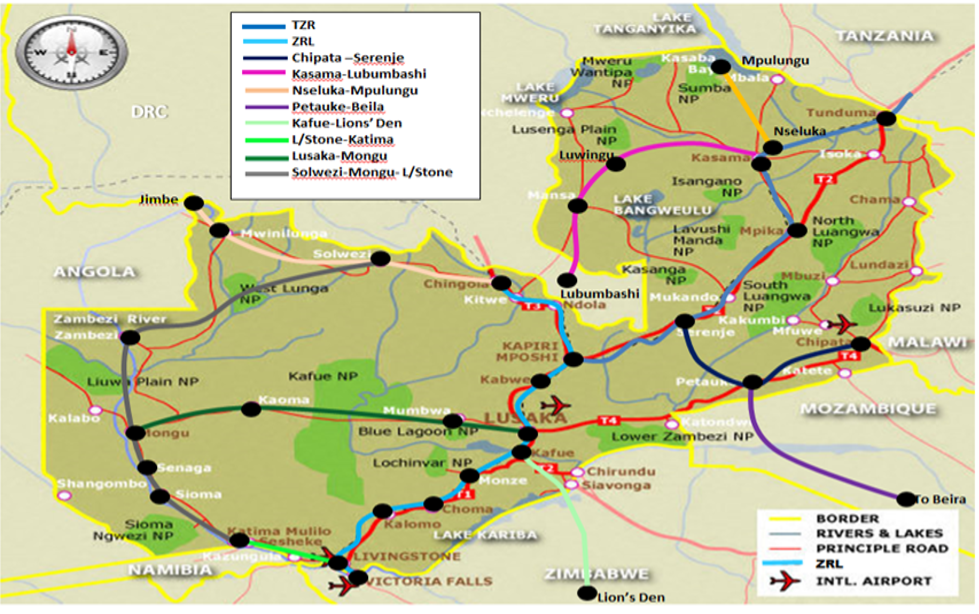
Zambia serves as a natural hub for regional integration, boasting two key railway systems: Zambia Railways Limited (ZRL) and the Tanzania-Zambia Railway Authority (TAZARA). ZRL is a strategic entity whose importance to the nation’s infrastructure and economy is paramount. Its role is crucial not only for domestic purposes but also for regional integration, offering connectivity to nearly all ports in the sub-region. Zambia stands as a pivotal destination, export, and transit point for major commodities, underscoring the strategic significance of its railway systems in enhancing economic activities and facilitating smooth trade flows across the region.
Zambia is poised to become a member of the Central Corridor Transit Transport Facilitation Agency (CCTTFA) in 2024. Daniel Longwe, Corporate Planning Manager at Zambia Railways Limited, shared insights on Zambia’s efforts to revitalize its railway sector during the December technical experts’ meeting on the African Integrated Railway Network Project in Addis Ababa, Ethiopia.
The Zambian government is actively seeking various funding sources to rehabilitate and modernize its railway infrastructure, acquire new rolling stock, and initiate greenfield railway projects. Currently, Zambia Railways’ performance is significantly below its designed capacity of 6 million tons per annum, a stark decline from past achievements, largely due to the deteriorating state of its infrastructure and rolling stock.
Longwe highlighted the exploration of funding options, including a potential regional railway corridor project under the European Union’s Global Gateway Africa Package, offering EUR150 billion for infrastructure development across Africa. Despite a rehabilitation agreement with a Swedish Consortium in 2021, implementation stalled due to the absence of sovereign loan guarantees from the Zambian government.
Efforts are underway to engage multilateral development institutions, such as the World Bank, International Finance Corporation, African Development Bank, and African Finance Corporation, for the necessary rehabilitation and modernization works. The aim is to enhance the capacity of the existing cape gauge railway infrastructure and ensure the availability of rolling stock to handle over six million tons per annum.
Zambia is also focusing on developing strategic greenfield projects, including a rail link from Kafue to Lion’s Den in Zimbabwe via Chirundu, which promises to shorten the distance to the port of Beira in Mozambique by about 1000 km. Feasibility studies for this project have been financed by the African Development Bank, with the next steps including seeking a developer and considering Public-Private Partnerships (PPPs) for implementation.
Other notable projects include the development of a 200km railway line from Livingstone to Sesheke, passing through Kazungula, and a 600km line from Chingola to Jimbe, aimed at enhancing connectivity within the Copperbelt region and beyond. Additionally, plans for a 192km line from Nseluka to Mpulungu aim to bolster northern connectivity.
— SIDEBAR/BLOCK—-
Towards the end of January 2024 – Zambia issued an Expressions of Interestfor the Nseluka to Mpulungu Railway Spur. The open call for Expressions of Interest (EOIs) for the financing, design, construction, operation, maintenance, and transfer of the Nseluka to Mpulungu Railway Spur situated in the Northern Province of Zambia.
— End SIDEBAR/BLOCK—-
Longwe emphasized Zambia’s openness to foreign direct investments and PPPs as crucial for the railway sector’s growth, highlighting Zambia’s strategic position as a natural hub for regional integration, linked to numerous ports across the sub-region.
He also touched upon the challenges of reduced speeds and capacity due to poor infrastructure and shared updates on urban mobility solutions, including the Lusaka Mass Transit Project aimed at decongesting the capital through the introduction of a Bus Rapid Transit system and potential elevated lines to accommodate urban transit needs in Lusaka, Ndola, and Kitwe.