Week: 2025-45Print Edition:Edit Article
  • 10. Completed
Item 1

Alstom Impact Report Reaffirms Deep Commitment to South Africa

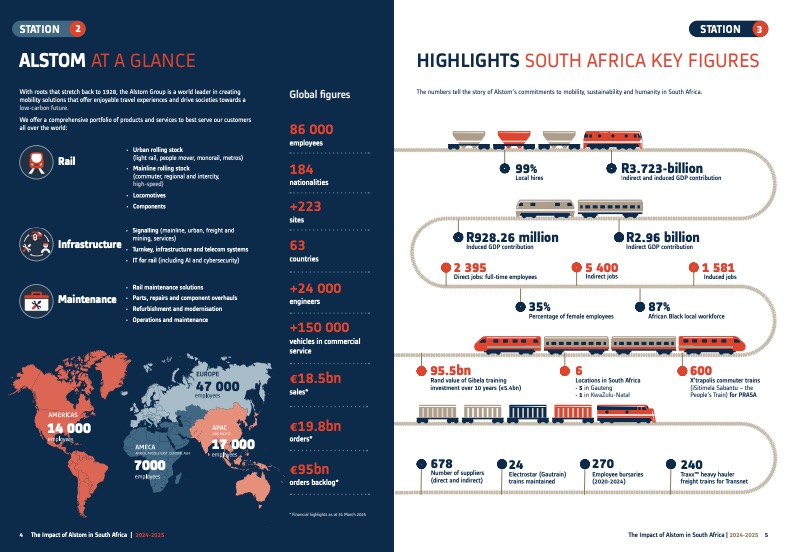
  • Alstom’s indirect contribution to the GDP was worth R2.96-billion over the fiscal year 2024/2025.
  • 56-billion was spent on local procurement with 678 local suppliers
  • Over 74,700 beneficiaries have received support through Alstom Foundation and local CSR initiatives since 2020.
  • Alstom has created 2,395 direct jobs, with an additional 6,981 indirect and induced jobs generated.

Alstom, a global leader in smart and sustainable mobility, has published its South Africa Impact Report for 2024-2025, highlighting the company’s profound and sustained commitment to the country’s economic and social development, including contribution to the national GDP, sustained industrial output, local procurement, job creation, skills development, and involvement in social upliftment. While showcasing the company’s extensive investments in local manufacturing and human resources, the report demonstrates its pivotal role in advancing the nation’s freight and commuter rail networks, which are crucial arteries for economic growth and public mobility.

Supporting the transformation of South Africa’s rail industry 

South Africa’s rail industry is experiencing a profound transformation, powered by bold reforms, cutting-edge partnerships, and a vision for inclusive growth and resilient railway systems.

This historic transformation is not only the result of Alstom’s investment and technological innovation, but also of the strategic direction provided by South Africa’s leaders. Alstom is proud to be working in partnership with the country’s public authorities to achieve a shared ambition for resilient infrastructure and economic opportunity.

A cornerstone of Alstom’s commitment is also its deep investment in the local industrial ecosystem. In the 2024/2025 financial year alone, the company spent R5.56 billion with 678 local suppliers, directing a significant portion to black-owned (R2.6 billion) and black women-owned (R1.3 billion) enterprises. “We are more than just present; we are invested. Our sites are not merely manufacturing facilities: they are engines of empowerment and transformation, creating a lifeline for opportunity and progress,” says Alstom Southern Africa Managing Director Tristan le Masne.

A strong industrial presence serving mobility projects

Based in Fourways, Johannesburg, and operating from five industrial sites – four in Gauteng and one in KwaZulu-Natal, including the continent’s largest train manufacturing centre in Nigel – Alstom is a significant force in the revitalisation of South Africa’s rail sector.

The company’s operations are fundamental to key national infrastructure projects, from manufacturing PRASA’s new commuter train fleet and Transnet’s freight locomotives to maintaining the world-class Gautrain network.

These projects are essential for connecting people to economic opportunities and moving goods efficiently from mines to ports, in the process of reducing pressure on the country’s overburdened road network.

Generating jobs and helping communities

Alstom’s commitment goes beyond business objectives. It is rooted in a genuine desire to support South Africa’s national priorities. Alstom strives to empower communities, foster local talent, and contribute to a future where mobility unlocks potential for all.

The company’s commitment to local procurement is matched by a focus on human capital. Alstom employs 2, 395 people in South Africa – 99% of whom are local hires – and has provided extensive technical, supervisory and management training to more than 2, 250 employees between 2020 and 2025.

Through its philanthropic arm, the Alstom Foundation, the company has been supporting local communities, with CSR initiatives focused on entrepreneurship for women and youth and education.

Committing to sustainable development

Alstom drives environmental sustainability, promoting energy-efficient rail as a solution to reduce carbon emissions. The company has also implemented green initiatives at its facilities, such as the solar PV plant at its Ubunye site, which generates 20% of its energy needs.

“As South Africa continues to advance its rail networks and industrial capabilities, Alstom remains dedicated to accompanying this journey — guided by the country’s strong leadership and our shared commitment to sustainable growth and inclusion,” concludes Tristan Le Masne.

Access the full Alstom South Africa Impact Report here:  ( I have added the document to link to)
Contributor:

Original Article URL 1Original Article URL 2
Alstom

Supporting Documents

Include as file uploads on live web version.

ff-9357031aaaca113d25160a78601a2943-ff-Alstom-Impact-report-2025-FA-flip2” target=”_blank” rel=”noopener”>ff-9357031aaaca113d25160a78601a2943-ff-Alstom-Impact-report-2025-FA-flip2

Item 2

Contributor:

Alstom Impact Report Reaffirms Deep Commitment to South Africa

  • Alstom’s indirect contribution to the GDP was worth R2.96-billion over the fiscal year 2024/2025.
  • 56-billion was spent on local procurement with 678 local suppliers
  • Over 74,700 beneficiaries have received support through Alstom Foundation and local CSR initiatives since 2020.
  • Alstom has created 2,395 direct jobs, with an additional 6,981 indirect and induced jobs generated.

Alstom, a global leader in smart and sustainable mobility, has published its South Africa Impact Report for 2024-2025, highlighting the company’s profound and sustained commitment to the country’s economic and social development, including contribution to the national GDP, sustained industrial output, local procurement, job creation, skills development, and involvement in social upliftment. While showcasing the company’s extensive investments in local manufacturing and human resources, the report demonstrates its pivotal role in advancing the nation’s freight and commuter rail networks, which are crucial arteries for economic growth and public mobility.

Supporting the transformation of South Africa’s rail industry

South Africa’s rail industry is experiencing a profound transformation, powered by bold reforms, cutting-edge partnerships, and a vision for inclusive growth and resilient railway systems.

This historic transformation is not only the result of Alstom’s investment and technological innovation, but also of the strategic direction provided by South Africa’s leaders. Alstom is proud to be working in partnership with the country’s public authorities to achieve a shared ambition for resilient infrastructure and economic opportunity.

A cornerstone of Alstom’s commitment is also its deep investment in the local industrial ecosystem. In the 2024/2025 financial year alone, the company spent R5.56 billion with 678 local suppliers, directing a significant portion to black-owned (R2.6 billion) and black women-owned (R1.3 billion) enterprises. “We are more than just present; we are invested. Our sites are not merely manufacturing facilities: they are engines of empowerment and transformation, creating a lifeline for opportunity and progress,” says Alstom Southern Africa Managing Director Tristan le Masne.

A strong industrial presence serving mobility projects

Based in Fourways, Johannesburg, and operating from five industrial sites – four in Gauteng and one in KwaZulu-Natal, including the continent’s largest train manufacturing centre in Nigel – Alstom is a significant force in the revitalisation of South Africa’s rail sector.

The company’s operations are fundamental to key national infrastructure projects, from manufacturing PRASA’s new commuter train fleet and Transnet’s freight locomotives to maintaining the world-class Gautrain network.

These projects are essential for connecting people to economic opportunities and moving goods efficiently from mines to ports, in the process of reducing pressure on the country’s overburdened road network.

Generating jobs and helping communities

Alstom’s commitment goes beyond business objectives. It is rooted in a genuine desire to support South Africa’s national priorities. Alstom strives to empower communities, foster local talent, and contribute to a future where mobility unlocks potential for all.

The company’s commitment to local procurement is matched by a focus on human capital. Alstom employs 2, 395 people in South Africa – 99% of whom are local hires – and has provided extensive technical, supervisory and management training to more than 2, 250 employees between 2020 and 2025.

Through its philanthropic arm, the Alstom Foundation, the company has been supporting local communities, with CSR initiatives focused on entrepreneurship for women and youth and education.

Committing to sustainable development

Alstom drives environmental sustainability, promoting energy-efficient rail as a solution to reduce carbon emissions. The company has also implemented green initiatives at its facilities, such as the solar PV plant at its Ubunye site, which generates 20% of its energy needs.

“As South Africa continues to advance its rail networks and industrial capabilities, Alstom remains dedicated to accompanying this journey — guided by the country’s strong leadership and our shared commitment to sustainable growth and inclusion,” concludes Tristan Le Masne.

Access the full Alstom South Africa Impact Report here:  

Web

Content Visibility:

SEO Title
Alstom Reaffirms Deep Commitment to South Africa in 2024–2025 Impact Report
SEO Description
Alstom’s South Africa Impact Report highlights R2.96-billion GDP contribution, R5.56-billion local procurement, major job creation and sustained investment in manufacturing, skills and rail modernisation.
SEO Keywords


SEO Keyphrase
  • Company News
  • Finance & Investment
  • Light Rail & Trams
  • Locomotive Maintenance
  • Locomotives
  • Manufacturing
  • Passenger Trains
  • Public Transport
  • Rolling Stock
  • Signalling & Communications
  • Sub-Components
  • South Africa

Supporting Documents

Include as file uploads on live web version.

ff-9357031aaaca113d25160a78601a2943-ff-Alstom-Impact-report-2025-FA-flip2” target=”_blank” rel=”noopener”>ff-9357031aaaca113d25160a78601a2943-ff-Alstom-Impact-report-2025-FA-flip2

Item 2

Please tag Alstom on all platforms

Alstom has released its 2024–2025 South Africa Impact Report, confirming a sustained commitment to the country’s rail sector and economic development. The company reports R2.96-billion in GDP contribution, R5.56-billion in local procurement with 678 suppliers, and more than 74,700 beneficiaries reached through CSR initiatives since 2020.

With 2,395 direct jobs and thousands more supported across the industrial value chain, Alstom continues to play a central role in revitalising passenger and freight rail through major programmes for PRASA, Transnet and Gautrain, alongside long-term investments in manufacturing, skills and sustainability.

#Alstom #RailTransport #SouthAfrica #RailManufacturing #PRASA #Transnet #Gautrain #SustainableMobility #RailInfrastructure #Localisation #SkillsDevelopment #Industrialisation

Alstom’s 2024–2025 South Africa Impact Report confirms R2.96bn GDP contribution, R5.56bn in local procurement and more than 74,700 CSR beneficiaries. With 2,395 direct jobs and major national rail projects, the company strengthens its long-term commitment to South Africa.

#Alstom #SouthAfrica #RailIndustry #PRASA #Transnet #Gautrain #RailInvestment #SustainableMobility

Item 2

Contributor:

Alstom Impact Report Reaffirms Deep Commitment to South Africa

  • Alstom’s indirect contribution to the GDP was worth R2.96-billion over the fiscal year 2024/2025.
  • 56-billion was spent on local procurement with 678 local suppliers
  • Over 74,700 beneficiaries have received support through Alstom Foundation and local CSR initiatives since 2020.
  • Alstom has created 2,395 direct jobs, with an additional 6,981 indirect and induced jobs generated.

Alstom, a global leader in smart and sustainable mobility, has published its South Africa Impact Report for 2024-2025, highlighting the company’s profound and sustained commitment to the country’s economic and social development, including contribution to the national GDP, sustained industrial output, local procurement, job creation, skills development, and involvement in social upliftment. While showcasing the company’s extensive investments in local manufacturing and human resources, the report demonstrates its pivotal role in advancing the nation’s freight and commuter rail networks, which are crucial arteries for economic growth and public mobility.

Supporting the transformation of South Africa’s rail industry 

South Africa’s rail industry is experiencing a profound transformation, powered by bold reforms, cutting-edge partnerships, and a vision for inclusive growth and resilient railway systems.

This historic transformation is not only the result of Alstom’s investment and technological innovation, but also of the strategic direction provided by South Africa’s leaders. Alstom is proud to be working in partnership with the country’s public authorities to achieve a shared ambition for resilient infrastructure and economic opportunity.

A cornerstone of Alstom’s commitment is also its deep investment in the local industrial ecosystem. In the 2024/2025 financial year alone, the company spent R5.56 billion with 678 local suppliers, directing a significant portion to black-owned (R2.6 billion) and black women-owned (R1.3 billion) enterprises. “We are more than just present; we are invested. Our sites are not merely manufacturing facilities: they are engines of empowerment and transformation, creating a lifeline for opportunity and progress,” says Alstom Southern Africa Managing Director Tristan le Masne.

A strong industrial presence serving mobility projects

Based in Fourways, Johannesburg, and operating from five industrial sites – four in Gauteng and one in KwaZulu-Natal, including the continent’s largest train manufacturing centre in Nigel – Alstom is a significant force in the revitalisation of South Africa’s rail sector.

The company’s operations are fundamental to key national infrastructure projects, from manufacturing PRASA’s new commuter train fleet and Transnet’s freight locomotives to maintaining the world-class Gautrain network.

These projects are essential for connecting people to economic opportunities and moving goods efficiently from mines to ports, in the process of reducing pressure on the country’s overburdened road network.

Generating jobs and helping communities

Alstom’s commitment goes beyond business objectives. It is rooted in a genuine desire to support South Africa’s national priorities. Alstom strives to empower communities, foster local talent, and contribute to a future where mobility unlocks potential for all.

The company’s commitment to local procurement is matched by a focus on human capital. Alstom employs 2, 395 people in South Africa – 99% of whom are local hires – and has provided extensive technical, supervisory and management training to more than 2, 250 employees between 2020 and 2025.

Through its philanthropic arm, the Alstom Foundation, the company has been supporting local communities, with CSR initiatives focused on entrepreneurship for women and youth and education.

Committing to sustainable development

Alstom drives environmental sustainability, promoting energy-efficient rail as a solution to reduce carbon emissions. The company has also implemented green initiatives at its facilities, such as the solar PV plant at its Ubunye site, which generates 20% of its energy needs.

“As South Africa continues to advance its rail networks and industrial capabilities, Alstom remains dedicated to accompanying this journey — guided by the country’s strong leadership and our shared commitment to sustainable growth and inclusion,” concludes Tristan Le Masne.

Access the full Alstom South Africa Impact Report here:  ( I have added the document to link to)

Print

Magazine Section

Africa Update

Instructions

Please use the cover of the report as the graphic