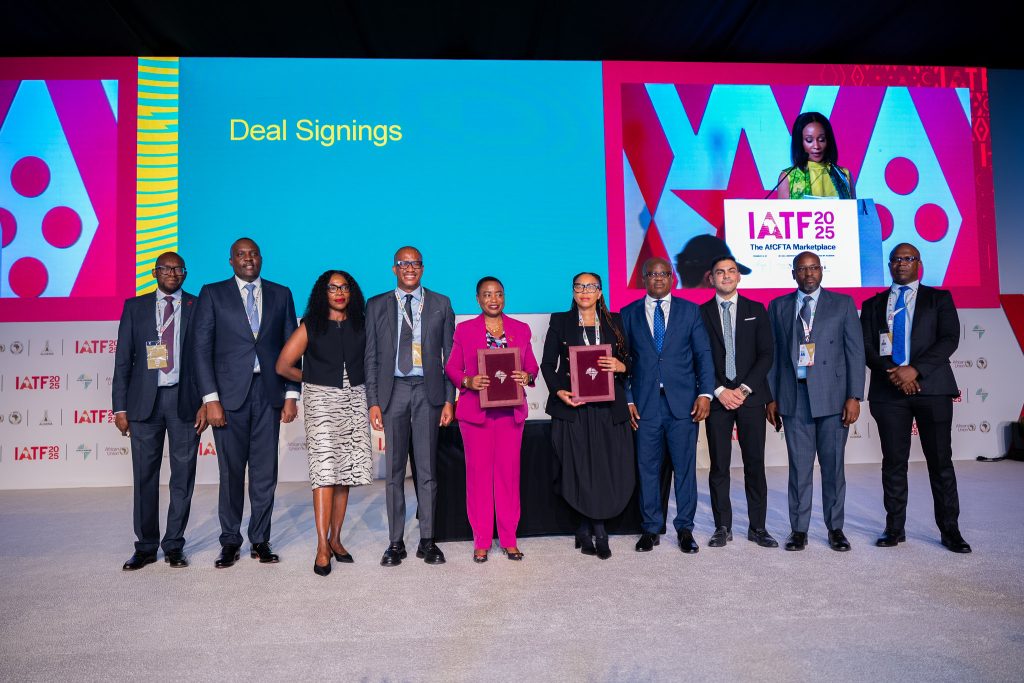
Afreximbank and South African Government Sign Landmark Joint Project Preparation Facility Agreement to Accelerate Infrastructure Development
The African Export-Import Bank (Afreximbank) has marked a major milestone in Africa’s infrastructure development by signing a landmark Joint Project Preparation Facility (JPPF) Agreement with the Government of the Republic of South Africa.
The agreement was formalised during a ceremony on the margins of the recently concluded Intra-African Trade Fair 2025 (IATF2025) in Algiers, Algeria. It aims to fast-track the preparation of critical infrastructure projects through the Government’s Infrastructure South Africa (ISA) Programme within the National Department of Public Works and Infrastructure.
The JPPF will co-finance the preparation and delivery of high-quality, bankable projects in essential sectors, including energy, transport and logistics, and digital infrastructure. This transformative partnership is set to unlock at least US$750 million in investments, significantly contributing to South Africa’s economic development.
By bringing together Afreximbank’s financial expertise and the strategic oversight of ISA, the initiative will build a robust pipeline of bankable projects needed to close South Africa’s infrastructure gap. It is expected to boost industrialisation and attract both public and private sector investment.
Speaking at the signing ceremony, Mr Kenny Molong, Deputy Minister in the Presidency of South Africa, highlighted the importance of the collaboration: “The slow progression of project concepts into fully implemented projects often stems from insufficient vigour in the project preparation phase. This partnership with Afreximbank positions us to transform concepts into viable infrastructure projects that will attract private sector financing and deliver socio-economic benefits. Collaboration is key; no single nation or organisation has all the answers.”
Ms Oluranti Doherty, Afreximbank’s Managing Director of Export Development, expressed her enthusiasm for the agreement: “We are pleased to partner with the Government of South Africa, a pivotal regional economic powerhouse, to address its infrastructure challenges. Our goal is to establish a cohesive and interconnected infrastructure ecosystem that will elevate South Africa’s competitiveness and spur economic development, extending benefits beyond its borders into the Southern African Development Community (SADC) region, thereby promoting intra-African trade and regional integration. Through this partnership, we aim to mobilise essential funding and technical expertise to de-risk projects at a critical stage in their development, enhancing the quality and speed of infrastructure delivery.”
Ms Doherty further underlined Afreximbank’s commitment to working with governments across the continent, emphasising the bank’s readiness to replicate this model elsewhere in order to maximise its impact across Global Africa.
Ms Mameetse Masemola, Acting Head of Infrastructure South Africa, also welcomed the collaboration, saying: “This is a huge milestone for ISA that will go a long way in developing a credible infrastructure pipeline as mandated by H.E President Cyril Ramaphosa.”
The recently concluded IATF2025 was a resounding success, surpassing its targets. The event attracted over 112,000 participants both in person and online, generating more than US$48 billion in trade deals. With over 2,100 exhibitors and attendance from 20 Heads of State and Government representatives, ministers, senior officials, and business leaders, it proved to be a key platform for advancing African trade and investment.
Introduced in 2018, the IATF serves as a platform for businesses to showcase goods and services, explore opportunities, and exchange information. It plays a central role in unlocking the potential of the African Continental Free Trade Area (AfCFTA), which offers access to a single market of more than 1.4 billion people and a GDP exceeding US$3.5 trillion.
This landmark agreement signals a decisive step forward in Africa’s infrastructure development, reinforcing the importance of collaborative frameworks in driving investment, industrialisation, and regional integration.